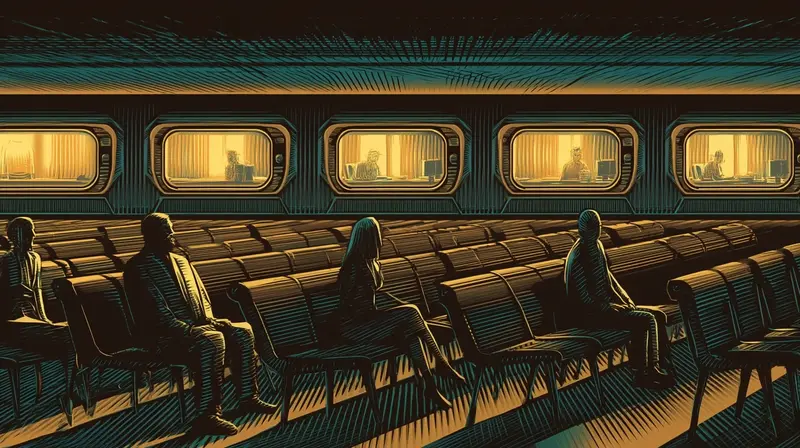
The Financial Times reports that AI has led employers including L'Oréal to return to in-person assessments for hiring — abandoning the remote, AI-mediated screening processes that were supposed to make recruiting faster and cheaper. They're not alone. Google and Cisco brought back in-person interviews last year. McKinsey is overhauling its entire recruiting process. The most advanced technology in modern history is driving the job market back to the most basic form of human evaluation: sitting across from someone in a room.
Phase One: Companies Deploy AI
The story begins around 2019, when employers started using AI to filter the flood of applications that the internet had created. HireVue's AI-driven face and voice scanning promised to evaluate candidates from video interviews — reading facial expressions, vocal patterns, and word choice to predict job performance. Automated résumé screeners used machine learning to rank hundreds of applicants in seconds. The technology was forcing career coaches to adapt their advice: candidates needed to write for algorithms, not humans.
The promise was efficiency. Instead of hiring managers reading 500 résumés, AI would surface the top 20. Instead of conducting 50 phone screens, AI would rank candidates automatically. The human would only appear at the final stage.
Phase Two: Candidates Fight Back
Then ChatGPT launched, and the arms race began.
By mid-2024, about half of all job seekers were using AI chatbots to write résumés, craft cover letters, and complete take-home assignments. A UK study found that employers running graduate schemes received an average of 140 applications per position — many AI-generated, many indistinguishable from human-written ones. The screening AI that was supposed to filter candidates was now evaluating candidates who had been optimized by a different AI.
By June 2025, the New York Times was reporting that AI-generated résumés were overwhelming employers. The applications looked perfect — polished, keyword-optimized, tailored to each job description. They were also, increasingly, fictional. AI could generate a plausible work history, fabricate project descriptions, and match any job posting's requirements with surgical precision. Employers couldn't tell which candidates were real.
Phase Three: The System Breaks
The AI-on-AI hiring loop produced a cascade of failures. The Financial Times reported that the AI arms race between employers and jobseekers wasn't going well for anyone. Job interviews became more grueling as companies added layers of verification — technical tests, live coding challenges, multi-day assessments — to pierce through AI-polished applications. Viral TikTok videos showed glitchy AI bots conducting job interviews, alienating the candidates companies were trying to attract.
The Washington Post documented the distrust on both sides: candidates suspected that AI was rejecting qualified applicants based on arbitrary keyword matching, while employers suspected that AI was manufacturing qualified candidates who couldn't actually do the job. Both were right.
Both sides deployed AI. Both sides lost. The signal — the thing hiring is supposed to detect — disappeared under layers of optimization.
The fundamental problem was structural. AI screening worked when only employers had AI. The moment candidates gained access to the same technology, the system collapsed. Every optimization the screener learned, the applicant's AI could reverse-engineer. The hiring pipeline became a contest between two AIs, with the human — the actual candidate — increasingly irrelevant to the process.
Phase Four: Return to Analog
So the companies that had been most aggressive about AI-powered hiring started walking it back.
- Mar 2025 Google and other companies consider bringing back in-person job interviews to counter AI-polished applications.
-
AUG 2025Google, Cisco, and others bring back in-person interviews. The return is explicit: in-person assessment is the only reliable signal left.
- Jan 2026 McKinsey pilots an overhaul of its entire recruiting process, rethinking how it evaluates candidates in an AI-saturated environment.
-
MAR 2026L'Oréal and others return to in-person assessments. The cycle completes.
The Pattern
The hiring arc follows the same structural logic as chess grandmasters playing suboptimal moves. When everyone has access to the same AI, the competitive advantage shifts to whatever AI can't replicate. In chess, it's deliberate unpredictability. In hiring, it's physical presence — the one signal that can't be generated, optimized, or faked by a language model.
In-person assessment is slower. It's more expensive. It requires candidates to travel and hiring managers to block calendars. It is, by every efficiency metric, a step backward. And it's the only process that works when both sides have AI.
The companies returning to in-person hiring aren't Luddites. Google and Cisco are among the most AI-forward employers in the world. They're not rejecting AI — they're responding to what happens when AI saturates a two-sided market. The screener and the applicant optimized against each other until the process produced noise instead of signal. The fix wasn't better AI. It was less AI.
Seven years ago, HireVue scanned faces to evaluate candidates. Today, the most sophisticated companies in the world have concluded that the best hiring technology is a conference room and a handshake. The tools changed. The problem didn't. And when both sides of the table have the same tools, the advantage goes to whoever puts them down first.