 Elena Voss
Five. That's how many years it took to privatize the internet. ARPANET was a government research network. NSFNET was a publicly funded national backbone. In 1990, NSF contracted with a for-profit consortium to run backbone operations. By April 1995, the NSFNET backbone was decommissioned and commercial networks had taken over entirely. Five years from public infrastructure to private market — extraordinarily fast by any historical standard. Rural electrification took decades. The interstate highway system took decades. The internet took five years, and the consequences of that speed are still playing out.
The Public Network
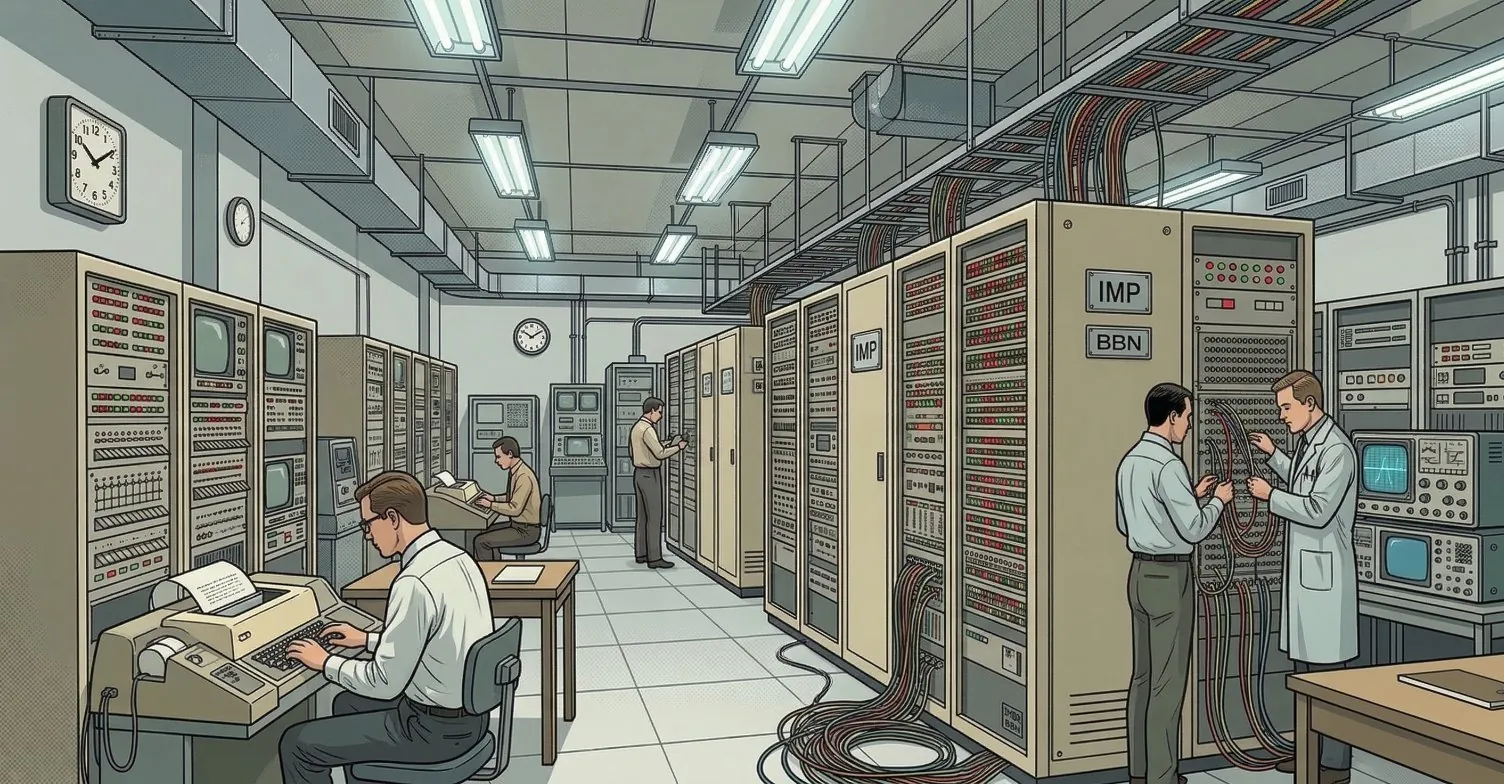
The internet's economic history is unique among American infrastructures because it began as neither a competitive market nor a private monopoly but as a publicly funded research network. ARPANET, funded by DARPA beginning in 1969, established the architectural principle that would define internet economics: packet switching over shared infrastructure. Unlike the telephone network, which dedicated a circuit between caller and receiver for the duration of a call, packet-switched networks break data into pieces that travel independently over shared paths. The economic implication was significant — packet networks have fundamentally lower costs per unit of capacity than circuit-switched networks, because idle bandwidth on any given link is available to any traffic traversing it.
The National Science Foundation took over backbone operations with NSFNET in 1985, connecting university supercomputing centers and creating a genuine national high-speed data network. NSF's acceptable use policy prohibited commercial traffic. The network was public. Then it wasn't.
The privatization created an initial burst of genuine competition. Hundreds of ISPs emerged, competing for dial-up subscribers. Backbone providers — MCI, Sprint, WorldCom, AT&T — competed fiercely on capacity and price. Internet access in the late 1990s was competitive in a way that local telephone service had never been.
There was a reason for this. The competition rested on a regulatory foundation.
The Competitive Window

The Telecommunications Act of 1996 — the most sweeping overhaul of communications law since 1934 — required incumbent telephone companies to lease their copper local loops to competitive carriers at cost-based wholesale rates. The theory was elegant: if competitors could rent Bell copper at cost, they could offer competing internet and telephone service without building their own last-mile infrastructure. Dozens of competitive local exchange carriers — CLECs — used this unbundling to offer DSL service over Bell copper. Covad, Rhythms, NorthPoint. Real companies, real competition, real price pressure.
The CLEC experiment failed. The reasons illuminate the structural limits of access regulation.
The wholesale rate disputes were intractable. The Baby Bells argued that mandated rates were set below actual costs — making unbundling a form of regulatory taking. Simultaneously, the Bells had no incentive to maintain or upgrade the copper infrastructure that CLECs shared. Why invest in improving a network you're forced to share with competitors? The incentive was the opposite: invest in next-generation fiber that you could keep proprietary.
The FCC narrowed unbundling requirements in 2003. A D.C. Circuit decision restricted them further in 2004. Then, in 2005, the FCC reclassified DSL and cable broadband as "information services" rather than "telecommunications services" — placing them outside the Title II common carrier obligations that mandated unbundling.
This single classification decision — made without congressional action — was the pivotal event in broadband's economic history. It ended mandatory unbundling. It killed the CLEC industry. And it permitted cable and telephone companies to operate broadband as vertically integrated, non-access-obligated monopolies.
The Duopoly

Without mandated access, building competing last-mile infrastructure was economically irrational for any firm that lacked existing conduit. The incumbent telephone company had copper (and later fiber). The incumbent cable company had coaxial cable. Nobody else had anything. Most American broadband markets settled into a duopoly: telco DSL or fiber on one side, cable modem on the other. In rural areas, even the duopoly was absent — a single provider or no provider served the territory.
Cable companies entrenched their positions through municipal franchise agreements — the same governance structure that had created electrical utility territorial monopolies a century earlier. Cities granted exclusive cable franchises in exchange for build-out commitments and franchise fees. Those franchises became legally binding barriers to entry.
When Google Fiber attempted to enter residential broadband in Nashville and Louisville around 2013, it encountered exactly these barriers. The municipal rights-of-way were physically inaccessible without negotiating access to utility poles controlled by the incumbent telco — AT&T — which had every incentive to obstruct. AT&T sued. The pole attachment dispute is the physical manifestation of the natural monopoly bottleneck: conduit infrastructure — poles, ducts, rights-of-way — represents enormous sunk cost and is essentially impossible to duplicate economically. The company that owns the poles has leverage over everyone who needs to use them. Google, a trillion-dollar company, couldn't break through. The last mile held.
The Access Question
The net neutrality debate — from 2005 through the present — is, at its core, a classic utility access pricing dispute in internet-governance clothing. The underlying question is identical to the one regulators faced with railroad rate discrimination in the 1880s and with Bell's exclusion of non-Bell equipment in the 1960s: can a natural monopoly over physical infrastructure use that monopoly to discriminate among users of the infrastructure?
Broadband providers argued they needed pricing freedom to earn returns on their network investment. Content providers and edge companies argued that without non-discrimination obligations, ISPs would levy tolls on Netflix, YouTube, and any service that competed with the ISP's own offerings — exactly as railroads had charged discriminatory rates by shipper identity.
-
1969ARPANET. Publicly funded packet-switching network.
-
1985NSFNET. National backbone. No commercial traffic.
-
1995NSFNET decommissioned. Full privatization in five years.
-
1996Telecommunications Act. Mandatory unbundling of local loop.
-
2005FCC reclassifies broadband as "information service." Unbundling ends. CLECs die.
-
2015FCC Open Internet Order. Broadband reclassified as Title II (common carrier).
-
2017FCC reverses Title II classification under new administration.
-
2021Infrastructure Investment and Jobs Act. $65 billion for broadband.
The oscillation between pro-incumbent and pro-competition regulatory theory — Title II in 2015, reversed in 2017, proposed again in 2024 — is the exact pattern that characterized railroad, telephone, and electric utility regulation in their contested periods. The political economy of each swing is identical: incumbent operators lobby against access obligations; edge companies and consumer groups lobby for them; the outcome reflects which coalition has more influence at the moment.
The $65 Billion Admission
In 2021, the Infrastructure Investment and Jobs Act appropriated $65 billion for broadband deployment — the largest federal communications infrastructure investment since rural electrification. The Obama White House had already made the comparison explicit: broadband was "the electricity of the 21st century," and the Rural Electrification Act of 1936 was the template for federal broadband subsidy.
The numbers differ by an order of magnitude. The structural admission is the same: private markets failed to deliver universal access to essential infrastructure. The government must build what the market won't.
This is the same conclusion that 1930s policymakers reached about rural electricity — that private utilities had no economic incentive to extend service to sparsely populated areas where the cost per customer exceeded the revenue. The TVA and the rural electric cooperatives were the result. Ninety years later, the same market failure, the same structural response, different wires.
Five
Five years to privatize the internet. It was the fastest infrastructure transition in American history, and the speed produced a specific outcome: the regulatory framework never caught up. Electricity had 25 years between Edison's chaos and the first utility commission. Telephony had 20 years between competitive chaos and the Kingsbury Commitment. The internet went from government network to private duopoly so fast that the regulatory institutions are still arguing about which classification applies — telecommunications service or information service, common carrier or private platform — 30 years after the question first arose.
The last mile didn't care about the classification debate. The economics of trenches, poles, and conduit are the same whether the service running over them is labeled Title I or Title II. Two sets of wires are wasteful. One set of wires is a monopoly. The regulatory question is what to do about it. Thirty years in, the answer is still: $65 billion and a prayer.
Part of the Infrastructure Economics series