 Kai Chen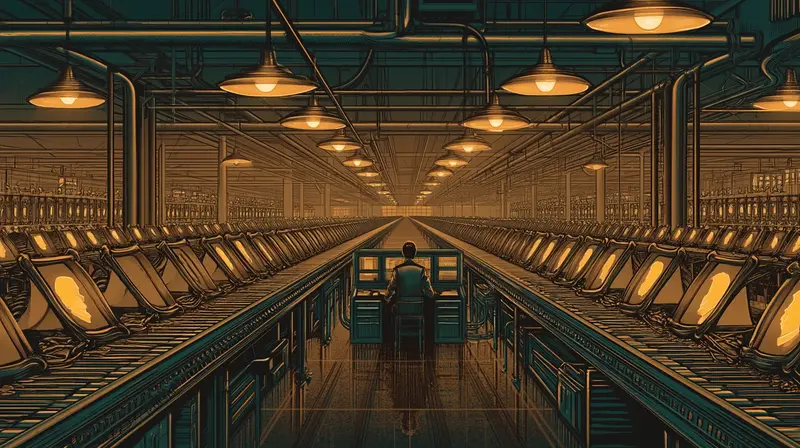
One person. One agent. 550 TikTok videos per day. That's not a projection — it's a deployed pipeline. The cost of content production crossed zero in Q1 2026, and the creator economy's response wasn't resistance. It was industrialization.
The Factory
The pipeline @maverickecom built isn't complicated. It's a supply chain:
AI generates a UGC persona — face, voice, personality. A voice clone is attached in seconds. CapCut handles editing, captions, and pacing. The videos push directly to TikTok Shop. What used to cost $300–500 per video now costs fractions of a cent per generation. What used to take a creator, a shoot, and a production timeline now runs continuously, unattended, 24 hours a day.
The math at scale:
| Category | Human cost | AI cost | Ratio |
|---|---|---|---|
| UGC video (floor) | $150–$300/video | $3–$5/generation | ~50–60× |
| UGC video (all-in) | $500–$2,000/video | $3–$50 | ~40–100× |
| Agency (50 vids/mo) | $22,500/month | ~$810/month | ~28× |
| Campaign (5 variations) | $1,100–$2,950 | $100–$285 | ~10× |
| Per-video floor (extreme) | ~$200 avg | $0.20 | ~1,000× |
@FynCas built the same factory on a different stack:
Nano Banana + MakeUGC + Veo3. Drop in a competitor's ad, pick an avatar, let AI rebuild it in seconds. Hundreds of ads per day. No $300 creators. No $10K/month agency. No products. The factory is a template now — documented, shareable, and being deployed across verticals.
Before AI, the human version of this was already industrial. @juliapintar's organic marketing stack posted thousands of videos daily for brands through cold-DM'd creators, notion handbooks, and GDrive feedback loops. Labor-intensive coordination to achieve volume. The AI version removes the labor. The volume stays. The coordination disappears.
The Threshold
Scale without indistinguishability is just spam. What changed in Q1 2026 is that three capability thresholds were crossed simultaneously.
Voice first. When Sesame shipped its conversational AI, the reaction from practitioners was visceral — not measured optimism but shock. @kimmonismus called it "absolutely indistinguishable" and noted it arrived "much earlier than expected." @jackndwyer flagged Orpheus TTS: expressive AI voice at $1 per hour, sub-250ms latency. Talk is, literally, cheap now.
Face next. HeyGen's UGC avatar launch was the clearest threshold crossing for video:
"No one can tell this is AI now." Not a researcher's claim — a practitioner watching the product ship and seeing what it produced. Realistic expression, body movement, lip sync. The tells that trained audiences had relied on — the uncanny valley, the flat affect, the eyes that don't quite track — were gone.
Motion third. @venturetwins found the proof in the wild:
An Instagram account posting AI-generated wedding stories at scale. The successful ones hit 5 to 10 million views. Zero "AI" comments. Not some — zero. The audience that would have caught a deepfake in 2023 isn't catching it in 2026, because the content isn't uncanny anymore. It's just content.
The threshold isn't a single capability. It's the convergence: when voice, face, and motion all cross indistinguishability in the same quarter, the entire pipeline from persona to published video becomes automatable without visible seams.
The Arbitrage
Markets reprice fast when a production input collapses. The operators who moved first were in LATAM:
$50K–$300K per month per vertical. No cameras, no production teams, no creative bottlenecks. The same arbitrage window that opened for early TikTok operators in 2020 — before incumbents figured out the algorithm — opened again in 2026 for AI UGC operators. @JamesEbringer says 2026 might be the last year the window is wide open. He's probably right. Arbitrages close when incumbents catch up. The incumbents are now the AI stack.
The one-person company running on $400/month in agent infrastructure isn't an edge case anymore. In content, it's the dominant production model for anyone who figured out the stack. The agencies that didn't automate aren't competing on quality. They're competing on trust and relationships — and those are much harder to maintain when the client can see the math on a tweet.
The Adobe survey found that 86% of creators already use generative AI tools. That number reframes the displacement narrative. Creators aren't being replaced wholesale — the entrepreneurial ones are running the factories. The ones being displaced are the ones who treat creation as a craft rather than a production problem. @venturetwins' Pixar short — a full AI-animated short film produced by one person in 12 hours — is the clearest illustration: the capability went to the person willing to orchestrate it, not the person who resisted.
The Detection Paradox
Here is the structural tension the piece turns on:
AI-generated text and human-written text are linearly separable. That's a precise technical claim: you can draw a line — a hyperplane — in the feature space that puts AI content on one side and human content on the other. Detection isn't hard. A competent ML engineer can build it. @liquiditygoblin did it as a personal project to stop seeing slop in their feed.
And yet: no major platform has deployed content-level AI detection at scale. A Northumbria University model achieved 85% accuracy distinguishing AI from human text. TikTok rolled out an AI detection update in late 2025 — framed not as enforcement but as a tool that lets users choose how often they see AI-generated videos. A preference dial, not a platform integrity mechanism. Meta released Video Seal, a watermarking tool. OpenAI added C2PA metadata to DALL-E images. All opt-in. All bypassable. None mandatory.
The tell is in that framing: "how often they see AI-generated videos." Not "whether AI content is allowed." Not "what happens when AI content violates provenance rules." Whether you prefer to see more or less of it — as if it were a content taste preference like "more cooking, fewer sports." The algorithm still optimizes for engagement. The factory produces engagement. Deploying real enforcement would require a platform to throttle content that's performing. No ad-supported platform will do that voluntarily.
This is the same structural dynamic as social media misinformation: the technology to detect it exists, the incentive to deploy it doesn't. The factory produces what the algorithm rewards. The algorithm isn't going to penalize its own feed.
Detection is technically solved. Deployment would require a platform to throttle content that's performing. The factory produces the engagement the platforms optimize for. That's not a bug in the detection logic — it's a feature of the incentive structure.
The Factory Wins Distribution
The creative industries have faced displacement before. Desktop publishing replaced typesetters. Digital photography replaced film labs. Stock photo sites replaced commissioned photographers for routine work. In each case, the artisans who survived did so by moving up the value chain — into work that required judgment, taste, and client relationships that couldn't be commoditized.
The content factory is different in one structural way: it doesn't just commoditize production. It commoditizes optimization. The @maverickecom pipeline doesn't just produce 550 videos — it identifies winning hooks before filming, scales the ones that convert, and cuts the ones that don't. Automatically. The A/B testing loop that used to require a media buyer and a budget now runs on the same pipeline that produces the content. The factory learns.
Content used to be scarce because production was hard. The audience's attention was the scarce resource, but production constrained how much content competed for it. A creator making one video per day was competing with other creators making one video per day. The factory makes 550. It tests every hook. It scales every winner. Amazon felt the same pressure in publishing: the company had to limit authors to three book uploads per day per account to manage the volume of AI-generated titles flooding the platform. The content floor didn't just drop — it collapsed onto zero and kept going.
What emerges isn't uniform displacement. HEC Paris research documented the structural outcome: AI boosts content production, but creator visibility plummets. More content means less discovery for any individual creator. The market polarizes: a top tier of creators who wield AI as leverage — using it to produce more, iterate faster, and scale what works — and a long tail of commodity creators who competed on volume and now compete with infinite supply. The factory doesn't replace all creators. It replaces the 80% who were providing a production service rather than a distribution advantage.
The creator making one video per day isn't competing on production anymore. They're competing on the one thing the factory can't yet replicate at scale: the trust that comes from being a person, not a pipeline. For now, that matters. The wedding account with 5-10 million views and zero "AI" comments suggests it matters less than expected — and less every quarter as the thresholds keep falling. The distribution question was always more important than the production question. The factory answers both.
More on TikTok, HeyGen, and AI content. Explore entity coverage via the Pulse API.